
India's consumption stocks, which have outperformed the broader market, are now facing significant pressure due to a gradual rise in fuel prices and the potential for higher inflation. Analysts warn that companies may be forced to pass on increased input costs to consumers, potentially hurting demand across both staples and discretionary categories, with a looming threat of deficient monsoon rainfall further exacerbating inflationary concerns.

Indian benchmark equity indices, Sensex and Nifty, experienced a decline in early trade, ending a three-day rally, primarily due to heavy selling in IT stocks and concerns over prolonged instability in West Asia.

Indian benchmark indices, Sensex and Nifty, closed marginally higher after a volatile trading session, driven by value buying in IT and select blue-chip counters, despite global crude price hikes and a weak rupee.

United States President Donald Trump has said that Iran is under close watch and a 'massive fleet' is heading towards the Gulf region.

If the conflict continues for a prolonged period, State-run oil companies may have to review retail fuel prices accordingly.
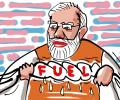
Following through announcements with enforcement of measures is key, as a run through recent Indian economic history shows, points out A K Bhattacharya.

Indian stock markets experienced a second consecutive day of losses, with the Sensex tumbling 852 points, as crude oil prices surpassed USD 100 per barrel due to stalled US-Iran negotiations and escalating geopolitical tensions in West Asia.

Immigrants' contribution to the US economy is disproportionate to their share of the population, meaning that losing them would shrink the economy even more than losing a random group of Americans, points out Sree Sreenivasan.
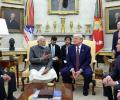
Prime Minister Narendra Modi and US President Donald Trump discussed the Middle East crisis, with a focus on the Strait of Hormuz.

External Affairs Minister S Jaishankar has emphasised India's commitment to safe maritime transit and condemned attacks on merchant shipping amidst the ongoing West Asia conflict and global energy market disruptions.

Gold prices are expected to remain volatile next week as investors track geopolitical developments in the Middle East and key macroeconomic data releases that could shape the sentiment in the domestic market, analysts said.


An Indian-flagged crude tanker safely departed from the UAE's Fujairah after loading oil, despite an attack on the oil terminal. The Indian government is closely monitoring the situation in West Asia to ensure stable fuel supplies and maritime safety.
Indian equities on Dalal Street saw volatility as global market trends and fresh tariff concerns linked to Donald Trump impacted investor sentiment. Track Sensex, Nifty50 movement and key market drivers for March 30, 2026.
Indian benchmark equity indices, Sensex and Nifty, snapped a three-day rally, tumbling nearly 1 per cent due to heavy selling in IT stocks, a jump in crude oil prices, foreign fund outflows, and fears of prolonged instability in West Asia.

Indian benchmark indices Sensex and Nifty experienced a significant tumble in early trade, driven by surging global oil prices, continuous outflows by Foreign Institutional Investors (FIIs), and persistent geopolitical uncertainties, particularly in West Asia.

Suryakumar Yadav's recent batting form has raised questions about his place in India's T20 plans, especially with the 2028 Olympics on the horizon and the emergence of young talent like Vaibhav Sooryavanshi.

Indian equity benchmarks, Sensex and Nifty, ended lower after a spectacular rally, with the Sensex tumbling 931 points, as renewed tensions in West Asia, particularly the risk to the ceasefire deal after Iran closed the Strait of Hormuz, dampened investor optimism.

Indian benchmark indices Sensex and Nifty closed higher, with the Sensex climbing 355.90 points, driven by positive state election results and better-than-expected Q4 earnings, despite ongoing geopolitical concerns.

The BSE Sensex and the Nifty 50 declined around 4.5 per cent each since the start of the West Asia conflict.

Indian benchmark indices Sensex and Nifty surged over 1 per cent, with the Sensex jumping 918.60 points, driven by strong buying in banking and financial counters and a positive trend in global equities, fuelled by hopes of easing West Asia tensions.

Nobody takes Pakistan seriously and therefore Pakistan's sudden mediating with almost immediate results of a ceasefire seems more contrived than real, points out Vice Admiral Biswajit Dasgupta (retd).

Indian equities on Dalal Street saw volatility as global market trends and weak rupee impacted investor sentiment. Track Sensex, Nifty50 movement and key market drivers for May 5, 2026.

The Federation of Indian Pilots, said the union has written to the DGCA raising concerns over the extension.

A new report suggests China's maritime vulnerability lies in the Strait of Hormuz, not Malacca, creating strategic competition in the Indian Ocean.

Spending has begun rising in infrastructure, construction and Indian firms have started to benefit.

Indian markets on Dalal Street rallied sharply as easing tensions in the US-Iran conflict and stable oil prices boosted sentiment. Track Nifty 50 and BSE Sensex performance and key global triggers.

The US Embassy acknowledged the attack in a post on X, urging Americans to avoid the facility 'until further notice' and announcing that all appointments had been cancelled.

The official 26-man squads for FIFA World Cup 2026.
Indian benchmark stock indices, Sensex and Nifty, closed nearly 1 per cent lower due to surging crude oil prices, weak global market trends, and significant foreign fund outflows, with geopolitical tensions and inflation concerns further dampening investor sentiment.

'The West Asia or the Gulf crisis has shown that what we develop as national infrastructure when things are not as bad as they could be, we forget to plan for adversities.'

Prime Minister Narendra Modi spoke with leaders from Oman, Kuwait, and Qatar, expressing concern over attacks in West Asia and discussing the safety of the Indian community.

The Pakistan Super League (PSL) is facing logistical and contractual challenges as several overseas players withdraw to participate in the Indian Premier League (IPL), which offers more lucrative contracts. The PCB is considering actions against players breaching contracts but fears deterring future talent.

Expanding the scope of hostilities, Zayed Port in Abu Dhabi, United Arab Emirates, was also targeted by missile strikes launched by Iran, according to a report by the Iranian state broadcaster, Press TV.

Indian markets on Dalal Street rallied sharply as easing tensions in the US-Iran conflict and stable oil prices boosted sentiment. Track Nifty 50 and BSE Sensex performance and key global triggers.

Former Indian cricketer Ravichandran Ashwin has criticised the idea of creating two separate T20I teams for Team India, advocating for 'A' team tours to provide players with more exposure instead.

Rahul Dravid said the European T20 Premier League offers an 'exciting opportunity' to grow cricket in Europe after becoming owner of the Dublin Guardians franchise.
Indian equity benchmark indices Sensex and Nifty tumbled over 1 per cent for the third consecutive day, driven by a sharp rally in crude oil prices, massive selling in IT stocks, and unabated foreign fund outflows amid ongoing geopolitical tensions in the Middle East.

Yogasana, the ancient Indian practice, is aiming to become a global sport and secure a place in the 2036 Olympics, with India hoping to host the Games in Ahmedabad. The sport has already been included in this year's Asian Games as a demonstration sport and is eyeing the 2030 Commonwealth Games. World Yogasana is working to meet the IOC's requirements for recognition, focusing on expanding its global reach and adhering to anti-doping standards.

Indian equities on Dalal Street declined in early trade on Monday as crude oil prices climbed amid fears of further escalation in the West Asia the war. Track Sensex, Nifty50 movement and key market drivers for Apr 6, 2026.
